Player guides
Livestock is coming
7 min read
The barley is in, the silo is full, and the November price is poor. Until now, you had to sell anyway or wait for a better month. Now, you can also give it to cattle and sell their meat.
We start with the finishing of Charolais. You buy young animals, you feed them up to their finished weight, then you sell them to the abattoir. Here is how it works, step by step.
Everything starts with a cattle shed
It is built in the Buildings app, from 5 to 200 places, at €1,000 a place. For twenty head, you therefore need €20,000. The first cattle shed creates the herd of the farm, the next ones add places.
You also need a manure store to keep the manure. It is paid by its capacity: €3,600 for 120 tonnes.
At the livestock dealer
Cattle are not bought at the co-op but from a livestock dealer, a few kilometres from your farm. He has his app on the desktop and his marker on the map. His stock changes every game month, so every real day. He offers four to six lots of 8 to 24 Charolais aged 7 to 9 months. In one lot, only bull calves or only heifer calves.
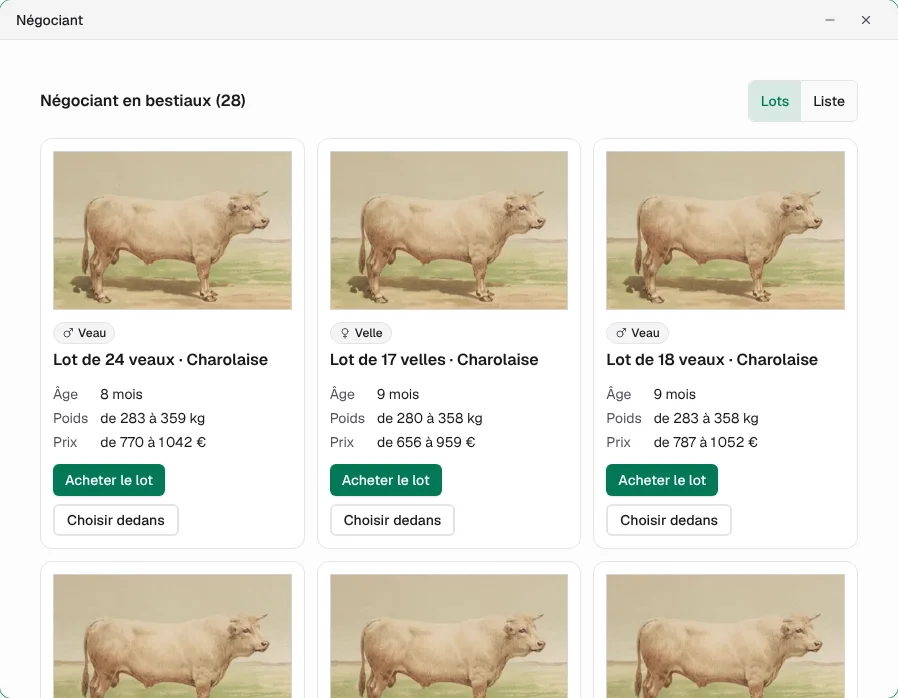
No need to take the whole lot. Each animal has its sheet and its price, and you can choose within the lot to keep only a few. Count around €2.80 a kilo of live weight for a bull calf, 10% less for a heifer calf. A bull calf of 320 kg therefore comes to about €900.
The delivery arrives the next day, in game days. Transport costs €8 per animal, plus 60 cents per kilometre: at about ten kilometres, €14 a head. You must have room for everyone, counting the animals already on their way, or the purchase is refused.
The store
Cattle do not eat straight from the silo or the fodder barn. They help themselves from the store of the herd, which holds the hay, the concentrate, the straw and the water. All the cattle sheds of the farm share the same store, and each place built makes it bigger.
Nothing to do every day. Full, the store lasts about a real week, enough to go away for a quiet weekend.
Your job is to fill it. “Restock” brings in what you have in stock: the bales from the fodder storage and the grain from the silo, which serves as concentrate. Wheat, barley, spring barley and maize all count, tonne for tonne. Like a job in the fields, it takes time and fuel. With a front loader or a telehandler for the bales and a grain trailer for the grain, it goes fast. By hand, it is much longer: thirty bales take eighteen hours of game time, against one hour with a good loader.
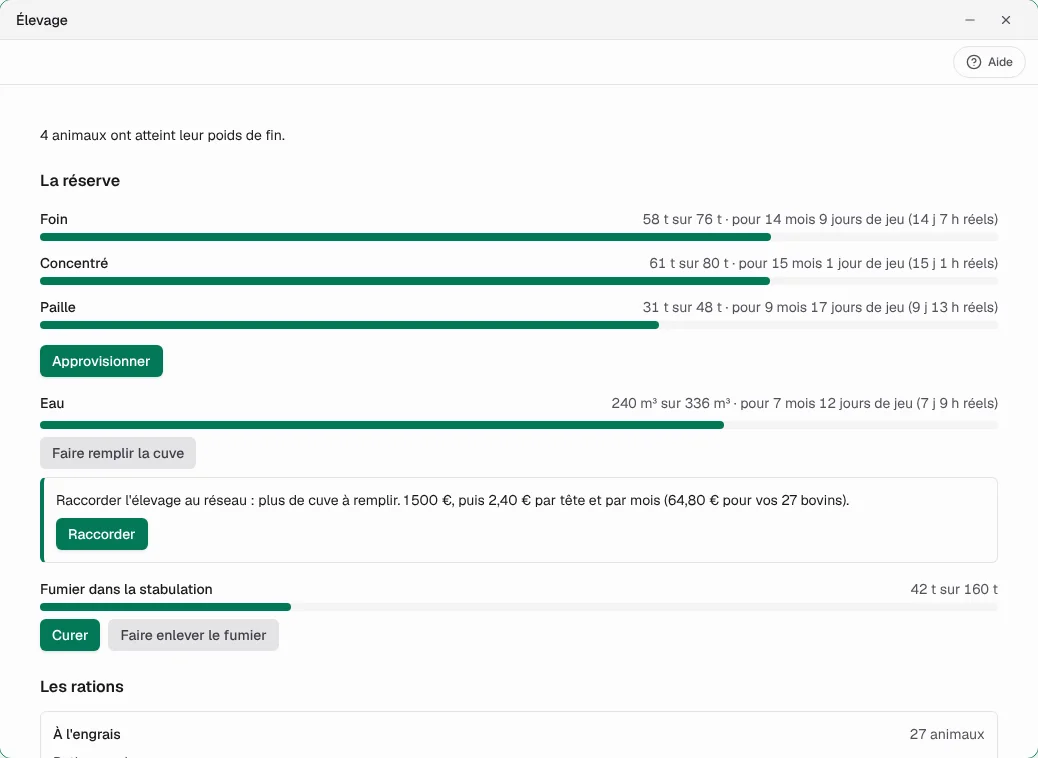
If you have not harvested yet, everything can be bought at the Market. Hay costs €120 a tonne, barley and straw today’s price plus 20%. Once delivered, they count as your own harvest. Straw comes from the harvest: see From harvest to bale.
For the water, a tanker comes to fill the tank of the herd, at €2 a cubic metre. You can also connect the herd to the mains for €1,500, then pay a bill of €2.40 per animal per game month. The water costs the same either way. With the mains connection, you simply no longer have a tank to watch.
Choosing a ration
All the finishing cattle eat the same ration, the one you choose. As long as none is chosen, they eat nothing, and the To do list reminds you of it.
The dry ration fattens fastest: 9.5 kg of concentrate and 1.5 kg of straw per head per game day, for 1.6 kg of gain. No hay, but it empties the silo fast. The hay and cereals ration puts 5 kg of each and gives 1.3 kg a day. The hay ration, 9 kg of hay and 2 kg of concentrate, gives one kilo a day.
On the same ration, a heifer calf puts on a quarter less weight than a bull calf. She also stops earlier, at 600 kg instead of 720 kg.
Mucking out the cattle shed
Each animal drinks 40 litres per game day and soils 4 kg of straw bedding. That manure builds up in the cattle shed, and when it reaches the limit, the animals suffer.
“Muck out” carries it to the manure store, with the same machinery as for the bales, or by hand. You have the manure store emptied whenever you like, for €3 a tonne.
When something runs short
As soon as a product of the ration runs short in the store, the animals stop gaining weight, then their body condition falls day after day. With neither ration nor water, an animal in full health dies in less than three real days. A notification warns you when a product has only two game months left, that is two real days. Once the store is filled again, the condition comes back up on its own.
From bull calf to young bull
The animals are weighed at the start of each game month. In the register, a gauge shows where each one stands against its finished weight, and its record keeps all its weighings. At twelve months, the bull calf becomes a young bull and the heifer calf a heifer.
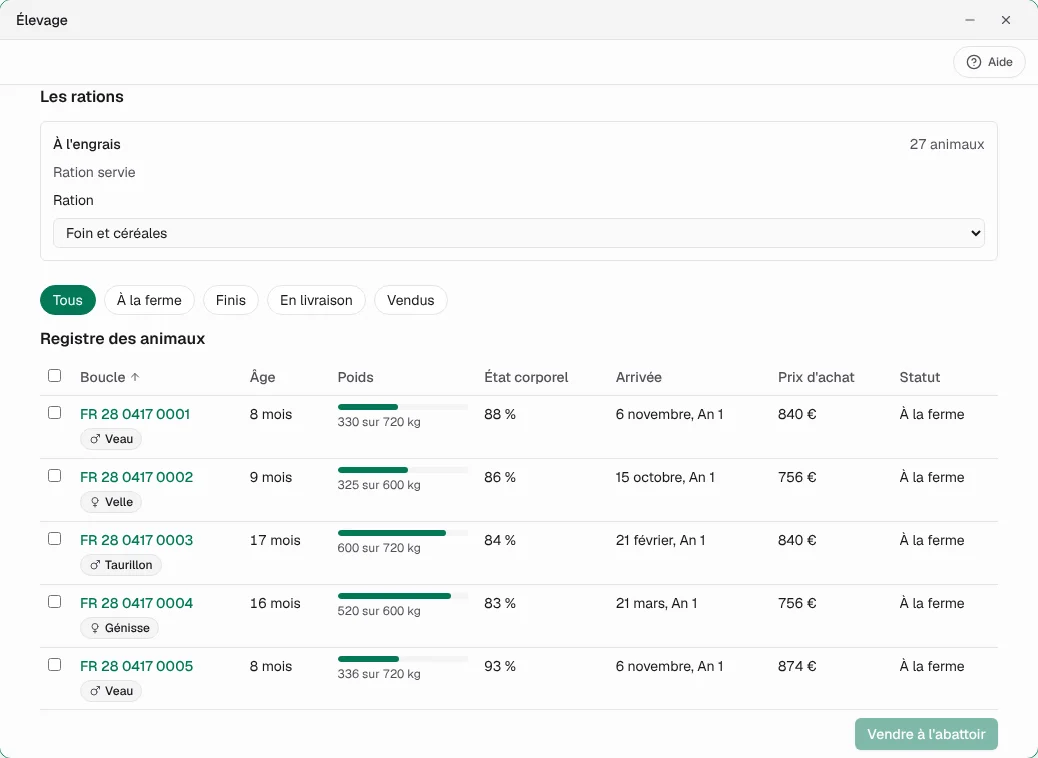
Do not keep them too long. After their finished weight, they only put on half of their gain, and nothing at their maximum weight. After 24 months, the abattoir takes 15% off the price.
Selling to the abattoir
The sale is made from the register. The “Finished” filter shows the animals that are ready: you tick them, then “Sell to the abattoir” opens the sale slip, one line per animal. The abattoir pays the carcass weight, 58% of the live weight for a young bull and 56% for a heifer, at today’s price.
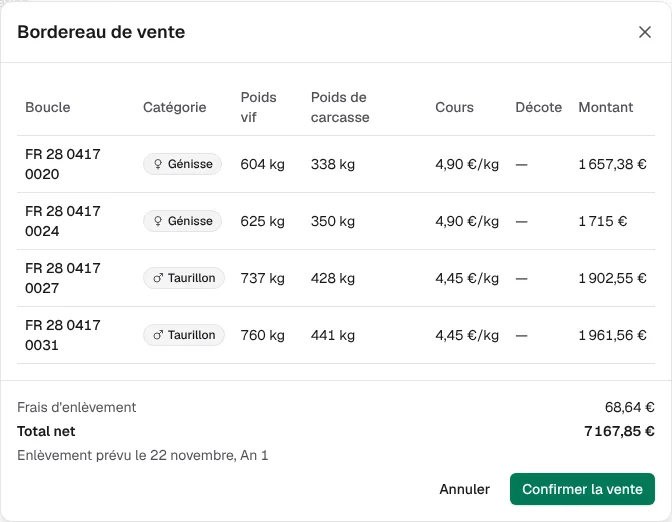
An example: a young bull of 760 kg gives 441 kg of carcass at €4.45 a kilo, a little over €1,900. The heifer is better paid per kilo, but she is lighter. The price changes with the season: at its highest in January and February, at its lowest in July and August. Below 80 points of body condition, the animal is paid less.
When you confirm, the price is fixed. If the price has changed in the meantime, nothing is sold and the game shows you the new sale slip. The abattoir comes for the animals the next day, in game days. Transport costs the same rate as at the purchase, worked out on the distance to the abattoir. You are paid at the collection, and until then, the animals sold keep eating and taking up their place.
What comes next
Hay is no longer only bought: meadows have arrived, and Mow, ted, bale: hay is coming explains how to make your own. Dairy cows followed: Dairy cows: milking, the milk tank and the milk tells how to milk them and sell their milk. Next will come births on the farm and other species. To manage the time all of this takes, see Ten hours a day.
All the rations and their values are detailed in the Help of the Livestock app.