Player guides
Sow, harvest, wait: the weather decides
5 min read
A field of wheat ready to harvest, a contractor to order, and it is raining. Until now, the game only warned you when you confirmed: the harvest was refused, and all that was left was to come back later and hope for better. The Weather app, which has just opened on the desktop, is there to avoid that.
Where the weather comes from
There is no single weather for the whole game: there is one per department. If your farm is in Eure-et-Loir, you have the same sky as your neighbours in the department, and not necessarily that of a farm in the Sarthe, thirty kilometres away.
That sky has five faces: sunny, cloudy, rain, storm, drought. It is updated every fifteen real minutes, that is three times per game day, and does not move in between. The change is not drawn wholly at random. It takes into account the present weather (rain comes more often after an overcast sky than in full sun) and the season (autumn is rainy, drought is a summer affair).
What you can do, in one line
We could have shown a big table, one job per row, one weather per column. We preferred a single answer, because in practice there are only three situations:
- in sunny, cloudy or dry weather, everything is possible;
- in the rain, only working the soil is left: you can plough, but the job lasts 30% longer and burns 30% more fuel. Sowing, spraying, fertiliser, the harvest, baling and bale collection wait;
- in a storm, nothing is possible.
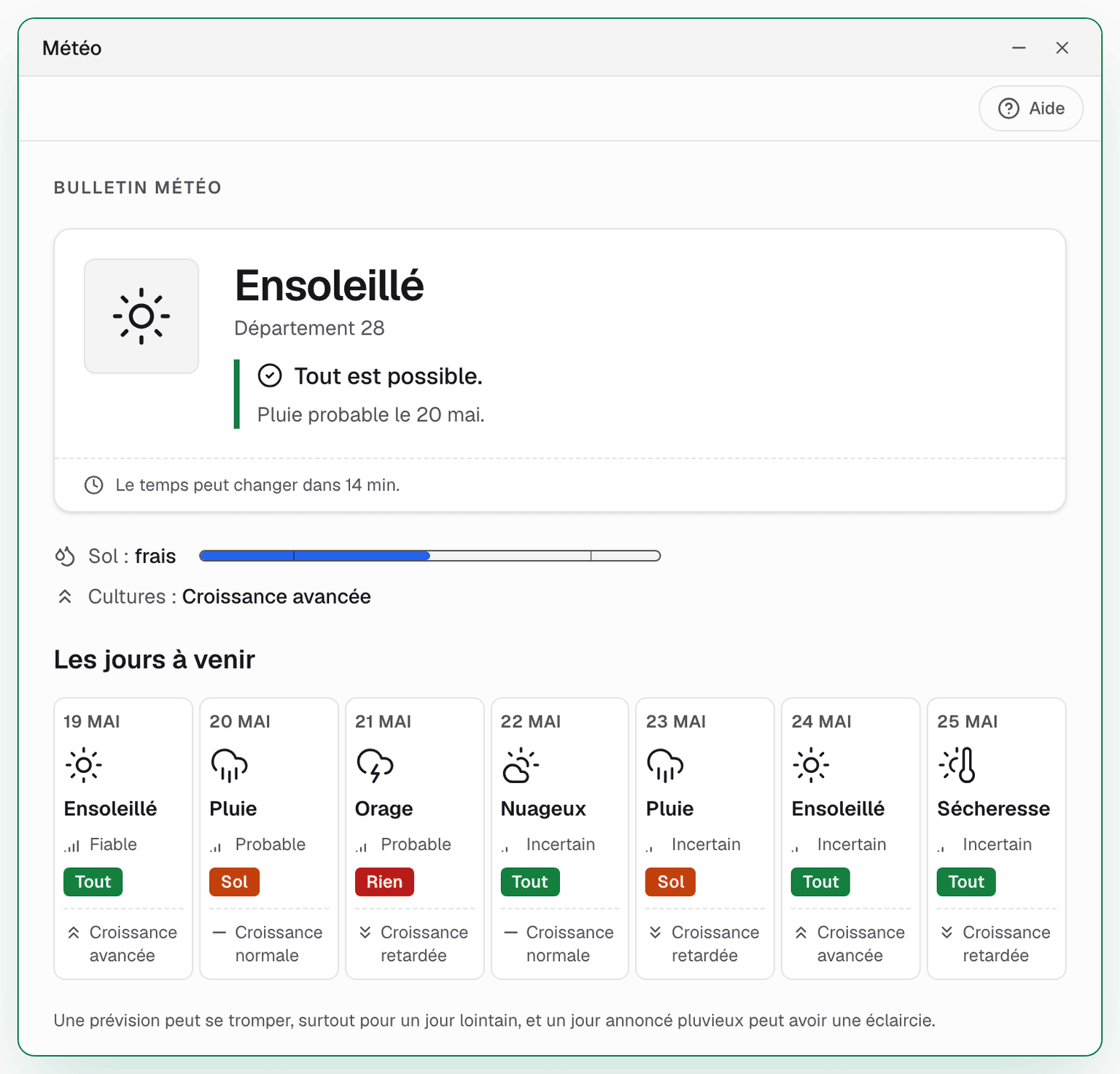
The app adds what really counts, what comes next: everything becomes possible again tomorrow, or on the contrary rain is likely on 20 May.
Forecasts that can be wrong
Under the forecast, seven cards give the weather expected for the next seven game days. Do not take them as a promise. Like a real forecast, they are wrong, and more and more so the further ahead they look. The one for the next day is right nine times out of ten: it is marked reliable. For the two days after, it falls to seven times out of ten, likely. Beyond that, it is one chance in two, and the card does not hide it: uncertain. The sentence of the forecast follows the same scale. A rain “expected” is almost sure, a rain “likely” less so, and a rain “possible, not certain” may very well never fall.
There is another reason to be careful. A card only gives one weather for the whole day, whereas the sky is updated three times in that same day. A day said to be rainy can therefore offer a few hours of respite. To know when to try your luck again, the forecast says in how many minutes the next reading will take place.
In Fields, the answer before the click
The app is only half of the change. The other half is in Fields, where the jobs are started. When the weather forbids a harvest, the window says so at once: the two ways of doing it, with your machinery or through the contractor, are greyed out, the reason is written underneath, and a button opens the forecast. No more confirming for nothing.
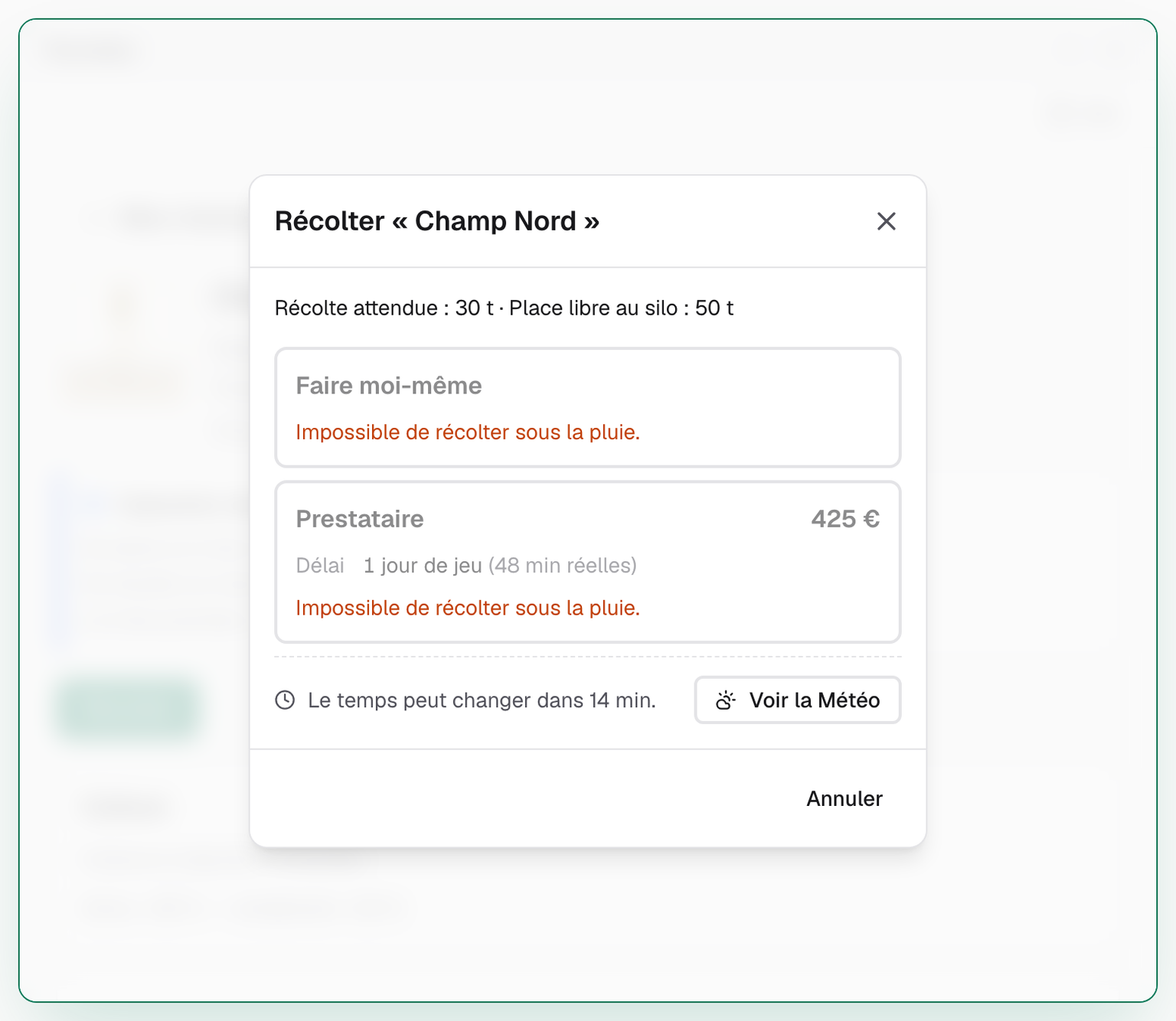
Along the way, a rule was put right. Spraying and fertiliser spreading used to go ahead in any weather, which made little sense next to a sowing refused in the rain. They too now wait for fine weather. A job refused costs nothing: neither money, nor product taken from the stock.
The soil keeps the water
The weather does not stop at the jobs, it also makes things grow. But a crop does not react to the weather of the day like a switch. What counts is the water the soil has kept.
Rain fills that store. On its own, it speeds nothing up, since the sun is missing. It is fine weather that makes things grow, and strongly as long as the soil is moist: sun after a few days of rain is the best moment of the year, the crops gain a quarter of their speed. On a dry soil, the same sun gives almost nothing, and the crop falls behind.
A storm fills the soil faster still, but it batters the crops and slows them a little. As for drought, it weighs much less on a soil that still has water than on a soil already dry.
So the forecast gives the state of the soil, dry, moist or waterlogged, next to what the weather does to the crops, and each card gives it for its day. That is also why the harvest date shown on a field remains an estimate: it moves forward or back with the weather there has been.
How to use it
The habit is simple: open the Weather before you commit. If a storm is forecast for tomorrow and the forecast is reliable, today is the day to harvest, or to order the contractor. If fine weather is only uncertain in five days, better not to build your whole calendar on it.
Two reassuring things to finish. An order already placed with the contractor is not lost when the rain comes: it waits for a weather that suits, at no extra cost. And a day of rain is not a day lost, since ploughing remains possible. It is only slower.
The detail of each weather is in the Weather page of the wiki, which the Help button of the app opens directly.